As an introduction into BA Fashion Marketing I visited Northampton Museum and Art Gallery along with my course members and tutors. The aim of the day was to get an insight into the history of shoes across the globe as well as the shoes that originated from Northampton.
The range of individual shoes present in the museum, right from the first ever shoe through to shoes worn today, I felt there was a key component that linked them all together. Each shoe had a story to tell. The shoes spoke of gender, ethnicity, profession, politics and religion. It was fascinating.
One of my favourite shoes from the museum were Queen Victorias wedding shoes from the 1840's. The shoes were made of white satin trimmed with bands of ribbon. The shoes also had ribbon ties fastened around the ankles which held the shoes in place. The size of the shoe was so tiny it was amazing to see. I feel the way in which the museum presented the wedding shoes spoke so much volume in itself portraying an important moment in British history. The Queens boot makers Gundry and Son had made the shoes for the special occasion.
Not only did the Northampton Museum reveal a great deal on British history and it's shoes but also how beauty was portrayed through footwear and the extremes people would go to wear the perfect shoe. The museum revealed an ancient practice called foot binding. The practice would seem cruel and painful however it was a very popular method of attracting a man as they found small feet very beautiful in a woman. The process of foot binding began at an early age (4-7). They would break every toe other then the big toe and the foot would then be wrapped with binding cloth. This custom was rich with tradition and it was believed to give the family of the daughter a higher social status.
The wedding shoes and the Chinese foot binding portray beauty in very different ways. Both of them tell a story. A moment in British history and a custom and lifestyle of Chinese women.
The way in which footwear has changed over time is fascinating and the way in which the museum documented this was fantastic. It enabled me to see these changes chronologically giving me a better understanding of the footwear and from which decade. I found the visit to the museum was so helpful in giving an understanding of how designers today have been inspired from shoes of the past. It has also given me a better understanding of the development of shoes over a long period of time.
Sunday, 13 October 2013

Tuesday, 8 October 2013
Northampton shoe gallery visit..
Visiting
the shoe collection at the Northampton Museum and art gallery was most
definitely an unforgettable and enlightening experience. As I stepped into the
footwear wonderland, groovy sounds of the 80’s and 90’s infiltrated my
eardrums. Perhaps this was a tool to engage visitors into the time machine of
shoes and based on my individual journey this was successful. In the first
room, shoes were categorized based on their cultural association, reinforcing
the fact that shoes do not just perform a simple function but also have the
ability to capture a memory; acting as an indication of time. The displays
varied from loud clumpy union jack decorated platforms from the 90’s to calm
and classy court shoes from the 50’s. Bold, chunky platforms, that would now
arguably be seen as ugly and ‘over the top’ in today’s fashion trends were
hugely evident. Nevertheless, this represented the loud cultural attitude of the
people of the glamorous and groovy era of the 60’s.
The
most thought provoking display was the one which is dedicated to the colour of
red. An assortment of footwear: thigh length boots, leather buckled, silky
ballet slippers etc.. were presented. This was an intriguing element of the
exhibition as it proves that even if a shoe is a different style or fabric; its
connotations can still be similarly communicated if its colour is the same- E.g. an expression of passion.
A
particular shoe that was highly eye-capturing was the ‘Super elevated Gillie
shoe, 1999’ designed by Vivian Westwood. Its noticeable height highly suggests
some discomfort with the purpose of this creation testing women to think is
looking attractive and standing out amongst the crowd really worth the pain?
In
the second room visited, the shoes presented were not just restricted to the 20th/21st
century. It was an honour to see early slipper type shoes from the period of
Ancient Egypt, Rome and China. But with the practicality of protecting feet from
the weather and rough ground taken care of, style was eventually introduced as
the factor of trend became relevant to society. ‘The first shoe fashion’; a
beautifully velveted blue craft embroidered with silver thread was 3-Dimensionally
displayed in a golden frame. This form of presentation fulfilled its purpose of
reinforcing the striking shoe’s unattainability.
The
exhibitors provided clever and engaging forms of interaction. There was an area to try on a range of funky
shoes which was highly amusing. The allowance to wear but not having the
opportunity to buy the shoes made the content of this display that much
exclusive and precious. Also provided was a selection of shoe fabric samples to
feel, another attempt to entice the audience’s senses. A distinct room in the
gallery contained an interactive touch device which contained memories and
stories of Northampton Shoemakers from the 19th/20th
century with their voices playing in the background. In addition, there was a
range of old shoe making machines which specialised in each stage of
production. Possibly this was to remind visitors that shoes are not just a
beautiful appearance but there is a high level of labour which goes into their
manufacture. These general sounds from the distant past which reminded me of
the World war times contributed to the exhibition’s historical value.
The
centre area of the room was dedicated to the contributions that present and
past Northampton inhabitants have given to the shoe industry; specific
photographs of relevant participants alongside historic items such as
certificates of recognition. The fact that this particular content was in the
middle is possible a connotation of the significance that the shoe industry has
contributed to the status of Northampton and Vice Versa.
This
exhibition differentiates from others that I have seen as it focuses on one
specific item in the fashion industry- the main reason for its unexceptionably. It was a privilege to
see so many beautiful creations in such a small space. Overall, my visit to the
Northampton shoe gallery has increased my awareness of the footwear industry. It has also reminded me that as well as being an accessory with simpler forms e.g. protection
and decoration, on the other hand such a simple item can be a highly
appreciated form of personal expression, landmark of time and a tool of
reminiscence.


Monday, 7 October 2013
Amber Smitham's Blog
On the 2nd October, I attended a tour into the archives of the Museum and Art Gallery to research the vast shoe collection on display. To any individual interested in the history of footwear, this was the ultimate location to discover items from over the centuries and across the globe, ranging from brogues to military boots to elaborately decorated Wellington boots even to 1930s fetish footwear. 11,000 pairs of shoes are kept inside this establishment, all containing their own piece of history and where they originated from.
Overall however, despite analysing many pairs from different eras I found myself fascinated with the trend of the 1920’s and in particular this pair of Black High Heeled Diamante Shoes which you can view below. My reasons for this are due to the exuberance of elegance and class, as well as combining liveliness, optimism and freedom from conformity. The shoemakers focussed hugely on attention to detail and influenced throughout the decade, which fabrics ranging from silk to gilded to reptile skin to tan leather. This was evident in each pair I found amongst the collection, demonstrating the normality of this trend. Obviously this was because of the outfits shifting in design, with dresses shortening, revealing the shoe itself, therefore becoming a major fashion statement in this era as shoes could not just be hidden underneath a long gown but needed to be selected with much more deliberation and care. In addition, the dance craze boomed by 1924, thus the introduction of ‘Mary Janes’, T-bar and cross-over straps and the 2 inch heel height became mass manufactured and a popular fashion statement was initiated. 1925 also gave way to international influences with the Exhibition of Decorative Arts in Paris, which exhibited Greek, Asian and Egyptian motifs.
The component of this shoe that initially strikes me, however, is the jewelled heel, a very feminine, fun, and outgoing feature that would appear to have been worn for an upper-class party or evening event. It would have been the perfect height and with the heel also widening towards the bottom, plenty of support to dance in. It was also, to my surprise, a recurring trend as today’s fashion consists of this style. The second eye-catching element is the diamante buckle, highly fashionable in 1926 which stunningly stands out boldly against a classic black velvet fabric, which was actually a safe option to the bright, wild colours many women wore. Buckles were often known to be encrusted with semiprecious materials for instance pearls and sequins again to add the glamorous eye-catching effect. This was definitely a decade that sparked off the importance of adding that 'something special' to your outfit but ultimately allowed you to feel liberated from old fashion habits in order to express postivity in society.
On the 2nd October, I attended a tour into the archives of the Museum and Art Gallery to research the vast shoe collection on display. To any individual interested in the history of footwear, this was the ultimate location to discover items from over the centuries and across the globe, ranging from brogues to military boots to elaborately decorated Wellington boots even to 1930s fetish footwear. 11,000 pairs of shoes are kept inside this establishment, all containing their own piece of history and where they originated from.
Overall however, despite analysing many pairs from different eras I found myself fascinated with the trend of the 1920’s and in particular this pair of Black High Heeled Diamante Shoes which you can view below. My reasons for this are due to the exuberance of elegance and class, as well as combining liveliness, optimism and freedom from conformity. The shoemakers focussed hugely on attention to detail and influenced throughout the decade, which fabrics ranging from silk to gilded to reptile skin to tan leather. This was evident in each pair I found amongst the collection, demonstrating the normality of this trend. Obviously this was because of the outfits shifting in design, with dresses shortening, revealing the shoe itself, therefore becoming a major fashion statement in this era as shoes could not just be hidden underneath a long gown but needed to be selected with much more deliberation and care. In addition, the dance craze boomed by 1924, thus the introduction of ‘Mary Janes’, T-bar and cross-over straps and the 2 inch heel height became mass manufactured and a popular fashion statement was initiated. 1925 also gave way to international influences with the Exhibition of Decorative Arts in Paris, which exhibited Greek, Asian and Egyptian motifs.
The component of this shoe that initially strikes me, however, is the jewelled heel, a very feminine, fun, and outgoing feature that would appear to have been worn for an upper-class party or evening event. It would have been the perfect height and with the heel also widening towards the bottom, plenty of support to dance in. It was also, to my surprise, a recurring trend as today’s fashion consists of this style. The second eye-catching element is the diamante buckle, highly fashionable in 1926 which stunningly stands out boldly against a classic black velvet fabric, which was actually a safe option to the bright, wild colours many women wore. Buckles were often known to be encrusted with semiprecious materials for instance pearls and sequins again to add the glamorous eye-catching effect. This was definitely a decade that sparked off the importance of adding that 'something special' to your outfit but ultimately allowed you to feel liberated from old fashion habits in order to express postivity in society.
Saturday, 5 October 2013
Yes! Shoes!!!
Yes! Shoes!!!
The Northampton museum of art and gallery is definitely a place to visit especially for the shoe fanatics. The showroom has a large large number of shoes for both sexes from each decade and its designer. The collection of shoes is over 10,000 to be precise 12,000.

 From the lot, the heel less shoe was the one that caught my eyes. Also known as the Lady Gaga's shoe today.
These heel less shoes has been around for some time now. Andre Perugia is said to be the founder of these shoes.He made shoes for a famous designer known as Paul Poiret.
Perugia first experiment of these type of shoes was in 1937, it is an eye catcher. The shoe creates an illusion that the wearer is suspended in the mid air. The heel less shoe is also known as Trompe L'Oeil or fool the eye shoes. A book he wrote "From Eve to Rita Hayworth" in which he said that the way to unveil a woman's personality was to study her feet. How amazing it is for a lady to walk in these shoes. This shoes tells you that fashion never fades it keeps coming back. Your feet does the talking on the runway and on the streets with these pair of shoes.
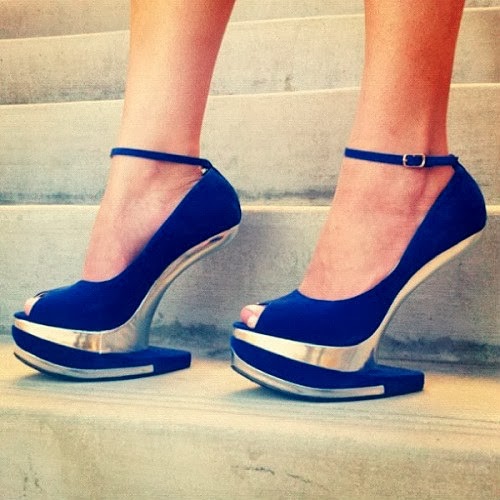

The shoe tour was an amazing experience for me since I am a lover of shoes I did enjoy the tour and would recommend it to everyone just to have the experience of visiting the museum to view all the shoes from all over the world. You will never regret this experience.
The Red Ballet Shoes
Northampton's Museum and Art gallery was filled with many incredible shoes, however the shoes that really caught my eye had to be the red ballet shoes that were worn by Moira Shearer in the movie 'The Red Shoes'. It is known that 25 pairs of red ballet pointe shoes were made for the movie however the pair in the photo were never worn (hence why they are such great quality!)
The ballet shoes really stuck out for me as I used to do ballet myself and it always amazed me how elegant dancers looked in pointe shoes and how they can dance on tip toes.
.JPG)
Safe to say rather Moira than me having to spend the majority of the time in pointe shoes due to their crippling effect! However, if i could dance in those ballet shoes and look elegant then that would be a bonus.
The shoes are in immaculate condition which makes them much more impressive and looks more expensive. Personally, i really like red shoes as i think they can add a dash of colour to an outfit if it was all black for example and it doesn't look cheap and tacky. Obviously the ballet shoes wouldn't be worn out in public, however the colour still draws attention to them and creates the storyline for the movie.
Thursday, 3 October 2013
The Northampton museum and art gallery visit

 Footwear fanatics pay attention, The Northampton museum and art gallery houses a world famous shoe collection, its is recognized nationally as a treasured and important collection playing homage to Northampton town 'cobbler town' being known for its shoe making history. The museum exhibits and celebrates that art of shoe making using fascinating interactive visual and interactive displays.
The museum showcases collections from a wide variety of cultures and era's, as well as iconic shoes and styles relating to films or performing.
 The collections and gallery have the ability to engage and inspire every genre of audience that visits.From Queen Victoria's satin ribbon wedding shoes when she married Prince Albert of Saxe-Coburg and Gotha in the Chapel Royal St. James. Also featured are the boots worn by Elton John himself in the 1975 Rock opera film 'Tommy' as well as classic shoes such as JuJu jellies who still produce the shoes in Northampton and have done for over 25 years now, which have recently become extremely popular in the media and on the high street in the summer months.
On the 19th of October I had the valuable opportunity to take a look around the museum and gallery and explore the gallery and archive, containing and excellent resource of factual information on shoe making and shoe traditions and generations. I enjoyed finding out about the different and unique shoes and exploring deeper into the stories behind them.
.JPG)
Education and entertaining, Northampton museum and art gallery preserves the fading art of shoe making inside it, It is undeniably worth a visit if you hold an interest in shoes, and its down to you to decide.....which shoe would you like to wear?

Northampton Museum and Art Gallery
.jpeg)
Are you the person that really love shoes? Are you the person that would
like to know more about different type of shoes past ? Northampton Museum and
Art Galerry is the right place. As many people know Northampton has a great
history for shoe manufacturing. People from all over the world visit this
museum in order to see how many different shape,high, lenght shoes can be.Thats why it is not surprising
why there are so many good reviews about this place.
When you first walk inside you enter into a bright , sky color foyer with
delicate white stairs and brown leather
armchairs . Walls are decorated
with great people such as Marilyn Monroe ,Mahatma Gandhi , William Rossi quotes.From
there you can choose to go three ways...
Upstairs you can find a wonderful exibition from stone age to age when shoe
manufacturing in Northampton was very popular.How rooms, shoe shops,
clothing,tools looked like. On your way out you can try local poeple clothing
from old times and take a picture with them as well.Going back down stairs ,
there is fascinating room with exibition of clothing, scooters from around
1960`s.At the same place there is gift shop where you can treat your self with
tea or coffe and buy trifle to a friend or family.When you pass to another room
, you feel like you traveled through time. 1960`s – 1990`s music makes you
really feel into that times.Shoes from the film “The Red Shoes”,local person-
Jeffrey West shoes, fetish collection and more.
The last but not least area is with shoes from differnt parts ,centurys of the world.
Memorable men`s and women`s shoe fetish collection. How in one`s own way there
are unique. Great attraction for younger generation , they have a chance to try
shoes from various places of the world.Also fascinating collection of removable
heels with swarovski`s for posh ladys.Furthermore , people who have no
clue how shoe making works , there is a seperate room with display of people
working in fabrics photos and equipment which were used to make marvelous shoes
in city of Nortampton.
To all the people that are intrested in fashion, shoes, history or is just
curious to know more about shoe manufacturing history have a chance to come to
Northampton Museum and Art Gallery to see them selves how amazing it is.
Subscribe to:
Posts (Atom)